Travian Server Script Download Video
How To 1:57 am: Update web pages with an FTP client (like FileZilla). This video describes that how to use the file transfer protocol prgram. First we have to download filezilla to our computer. Go to google and download it first into the computer. There is a username and password to use the FTP. Script Summary: Automaticly builds, send resources, train troops and farm in travian. Crop/farm finder. Install video: In the Filter field enter the country code of the server your playing on (e.g. 'ro' for the Romanian servers, 'de' for Germany, etc.) or the host.
UpdateStar is compatible with Windows platforms. UpdateStar has been tested to meet all of the technical requirements to be compatible with Windows 10, 8.1, Windows 8, Windows 7, Windows Vista, Windows Server 2003, 2008, and Windows XP, 32 bit and 64 bit editions. Simply double-click the downloaded file to install it. UpdateStar Free and UpdateStar Premium come with the same installer. UpdateStar includes such as English, German, French, Italian, Hungarian, Russian and. You can choose your language settings from within the program.
Contents • • • • • • • • • • • • • • • • • • • • Gameplay [ ] Travian is set in classical antiquity. Each player starts the game as the leader of a small, undeveloped village, surrounded by undeveloped resource fields. Developing these fields increases their resource output. The village can be developed by constructing new buildings and upgrading existing ones. Recruiting military units allows players to attack other villages to plunder its resources, and defend from enemy attacks. Villages may trade their resources with other villages if both villages have a marketplace.
The player may expand their realm by founding new villages, or by conquering other players' villages. Players can communicate with each other using in-game messages, and may join for military and economic co-operation with other players. Starting a game [ ] Players must register on the Travian website to join a game, providing an e-mail address, and creating a username and a password. The player must also choose a tribe to play the game with, and select a World, that represents a, to play in.
Entities in one World can only interact with other entities in the same World. Events that take place in one World do not affect other Worlds. Players may operate accounts in multiple Worlds, but operating more than one account in the same World is prohibited by the rules. However, multiple players may operate a single account. Worlds close registrations for new players after a certain number of players have signed up. After logging in, the player can follow a tutorial that guides them through various aspects of the game and offers rewards for successful completion.
At the start of the game, there is a 'beginner's protection' period, in which the player cannot be attacked, the length of which depends on the server. Tribes [ ] There are 5 playable tribes and two non-playable tribes in Travian. The playable tribes are the, the, the, the, and the. The player selects one of these 5 tribes during registration. Each tribe has different specialities. Romans can upgrade buildings and resource fields simultaneously, have powerful troops which are expensive to train, and have low-capacity merchants. Gauls have fast-moving troops with good defensive capabilities, and fast merchants.
Teutons are geared towards an aggressive style of play, and offer weak but cheap troops, as well as slow but high-capacity merchants. Once a tribe is chosen it cannot be changed, and all villages founded or conquered by the player will be of that tribe. The two tribes are the Natars and Nature. Natarian villages randomly spawn all over the map, and will gradually develop. Villages of players who have deleted their accounts will also have a chance of turning into Natarian villages.
These villages can be attacked and conquered by players. Natars also occupy the central area of the map, and will attack players' villages in that area. Natarian villages may hold ancient artefacts which give bonuses to those who possess them. Nature is the tribe to which animals occupying abandoned oases on the map belong. Unlike the other four tribes, Natural troops cannot attack other villages but may be attacked. It is possible to capture animals from oases and use them as defensive units.
Resources [ ] Developing villages and training units consume resources. Resources are produced by the resource fields that surround each settlement; their output can be increased by upgrading the fields and by capturing nearby oases.
There are four kinds of resources in Travian: wood, clay, iron and crop. Each resource is required to develop a village, with clay being the most demanded used resource for construction. Additionally, consumption of resources will vary based on the player's tribe: Roman troops require iron for their armour, Teutonic troops require wood, and Gallic troops require clay.
Military units and the village population consume crop, so the net crop production is lowered whenever the population grows or a new military unit joins the village. Troops can raid other villages to plunder resources. Resources can also be transferred to other villages unilaterally if the source village has a marketplace. Bilateral trade can take place when both villages have a marketplace, and one village accepts a trading deal offered by another. Buildings [ ] Buildings can be built and upgraded in the 22 building slots in the village centre. They cost time and resources to construct, and attract more people to settle in the village, increasing the population.
Buildings may have a prerequisite that one or more of the other buildings must be at a certain level. Each type of building has a different use. New villages start with the main building, which decreases the construction time of new extensions to the buildings and resource fields in the village. Warehouses and granaries allow the village to store more resources. Military units are trained at the barracks, stable, workshop, residence and palace, while military research is conducted at the academy and the armoury.
There are also buildings that enhance the resource production in the village. A treasure chamber allows the village to hold an artefact, and shows the list of the locations of all the artefacts in the game.
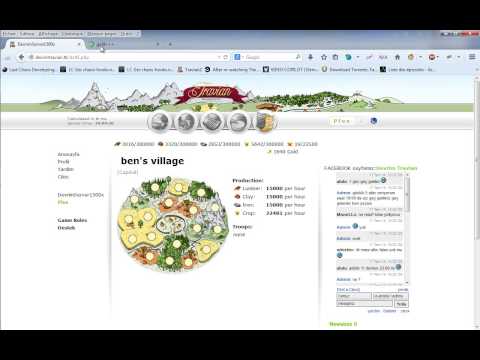
Villages [ ]. Language Proof And Logic Answers Pdf. A developed village. Each player starts the game with a single undeveloped village, designated as the capital. A village consists of the village centre, and 18 resource fields that surround the village centre. Up to 22 buildings can be constructed in the village centre. Of these, two are special-purpose building spaces, for the walls and the rally point.
In an undeveloped village, the resource fields are at level 0, and there is only a single building, known as the main building. Players can found or conquer additional villages to expand their realm, increase total resource production and help support larger armies. There are prerequisites for founding or conquering additional villages. The player must have accumulated enough culture points, which are passively produced by most buildings, and actively produced by hosting parties in the town hall. The number of culture points required depends on the total number of villages the player already controls.
The player must also have a palace or the residence building in a village he or she controls to be at a particular level. The level requirement depends on the number of villages founded or conquered by troops from that particular village. Once these criteria are met, the player may train three settlers to go and found a new village at a chosen vacant area on the map. Settlers must be given 750 of each resource before they start their journey.
When the settlers reach their destination, they will found an undeveloped village which will be under the player's control. Instead of founding a new village, a player may choose to conquer another village. The player may train an administrator (a Roman senator, a Teutonic chief or a Gallic chieftain) instead of three settlers. Unlike settlers, these units must be researched in the academy before they can be trained.
Administrators can be sent to another village, usually accompanied by other troops, where they will speak to the village's populace and reduce their loyalty to the defender. If the loyalty drops to zero, the village will join the attacker's realm. The defender will lose control of the village, and all troops originating from the village will cease to exist. Villages are destroyed if its population drops to zero as a result of a siege. However, a village cannot be conquered or destroyed if it is the a player's capital, so a player will always have at least one village.
Troops [ ] Troops are military units that allow the player to attack and defend villages. They can carry resources, so they can be used to raid other villages. There are mainly three classifications of troop: tribe, mobility and function. There are fifty different types of troop in Travian, ten for each tribe. Troops are either infantry or cavalry.
Most troop types are regular units, but each tribe has troop types to represent scouts, two types of siege engine, administrators and settlers. Each troop type has attributes which determine its training cost, upkeep, offensive capability, defensive capability against infantry and cavalry, speed and resource carrying capacity. Infantry is trained in the barracks, and cavalry is trained in the stable. Scouts are espionage units that can be used to spy on enemy villages, or defend from espionage attacks.
Siege engines, which are built in the workshop, allow players to destroy enemy buildings and defensive structures. Administrators and settlers are units that have the ability to conquer or found new villages, respectively. They are trained in the residence or the palace. At first, players may only recruit the most basic troop type of their tribe. To train more advanced troops, the player must research them in the academy in the village where they are to be trained. Troops may also require military buildings to be upgraded to a certain level before they may be researched.
Troops' offensive and defensive attributes may be improved by constructing an armoury to enhance their weapons and armour. Upgrading the barracks, stable and workshop allow faster training of troops. There are also buildings known as the great barracks and the great stable, which allow simultaneous training of the same troop type but at three times the cost. Roman villages can build a horse drinking trough to speed up training of cavalry and reduce their upkeep. Teutons can build a brewery which improves the offensive attributes of troops from that village.
There is also a special unit known as a hero, which can gain experience from battle. Heroes can equip items, embark on adventures, capture oases and produce resources. They can also accompany an army. Depending on their attributes, a hero may give an offensive or defensive bonus to the army that it accompanies. Items [ ] There are two types of items in the game; the first are artefacts, which gives bonuses to the holder, depending on the type of artefact; the second are equipment and consumables for the hero. Artefacts are items which are introduced mid-game, and give significant bonuses to those who possess them.
Upon release, they are placed in heavily defended Natarian villages, and can be acquired either by conquering the village, or by destroying the treasury in the target village and sending an army accompanied by the hero to capture the artefacts. All players with a treasury can see the locations of the artefacts. This section needs expansion. You can help. (May 2013) Bots and scripts [ ] In Travian, there has been widespread usage of and that automate actions for the player. Dj Muro Dig In Ice Rar. This led to implementing a system against users of these, which is still active in the game.
The system was made to detect users of bots and scripts, and then prompting them to fill in a, later this was enhanced to give immediate punishment. Reception [ ] Travian was ranked at second place in the medium games category of Gamesdynamite's Superbrowsergame Award in 2005, and was chosen as the Most Innovative Browser Game of 2005 by Coole Browsergames.
In 2006, Travian won the Superbrowsergame Award, in the large games category, and was chosen as the Browser Game of the Year 2006 by Coole Browsergames. Christian Donlan, game reviewer, described Travian's version 2 interface as 'ugly', with a 'primitive cartoon style' and a bad colour scheme. He characterised the game as 'functional rather than beautiful', with an interface that is 'uncluttered'.
Travian was chosen as the Browser Game of the Year 2011 in the classic games category by GforGaming's jury. References [ ]. • Klimmt, Christoph; Schmid, Hannah; Orthmann, Julia (2008-03-11). Motivations of browser gamers: The case of Travian players.. • Klimmt, Christoph; Schmid, Hannah; Orthmann, Julia (2009-04-10). 'Exploring the enjoyment of playing browser games'..
• Thon, Ingo; Landwehr, Niels; De Raedt, Luc. (PDF) from the original on 2014-03-14. • Milolidakis, Giannis; Kimble, Chris; Akoumianakis, Demosthenes (2009).
'A Practice-Based Analysis of an Online Strategy Game'. Leveraging Knowledge for Innovation in Collaborative Networks. IFIP advances in information and communication technology. • Assmann, Jakob J.; Sandner, Philipp; Ahrens, Sophie (2009-01-05). • Assmann, Jakob J.; Drescher, Marcus A.; Gallenkamp, Julia V.; Picot, Arnold O.; Welpe, Isabell M.; Wigand, Rolf T. Paper 335, Sustainable IT Collaboration Around the Globe, 16th, 2010.,:.
External links [ ] • • (in German).